Blog
11 min read
How to Write a Job Ad That Attracts Top Talent
Learn to craft a compelling job ad that attracts top talent. Stand out in a competitive market and enhance your application quality today!
Learn to craft a compelling job ad that attracts top talent. Stand out in a competitive market and enhance your application quality today!

A job ad is a structured communication tool that defines a role, its requirements, and its value to attract the right candidates efficiently. Most hiring managers treat it as a formality. The best ones treat it as a sales pitch. The difference shows up directly in application quality and volume. Inclusive, gender-neutral language alone increases applications by 42%. That single data point reframes the entire exercise. A job advertisement is not a checklist of requirements. It is a targeted message designed to make the right person stop scrolling and apply.
Egypt’s labor market is competitive across sectors from technology and finance in Cairo to manufacturing and logistics in the Delta. Hiring managers here face a real challenge: too many unqualified applicants, too few strong ones. The solution starts with the employment ad itself, long before any screening begins.
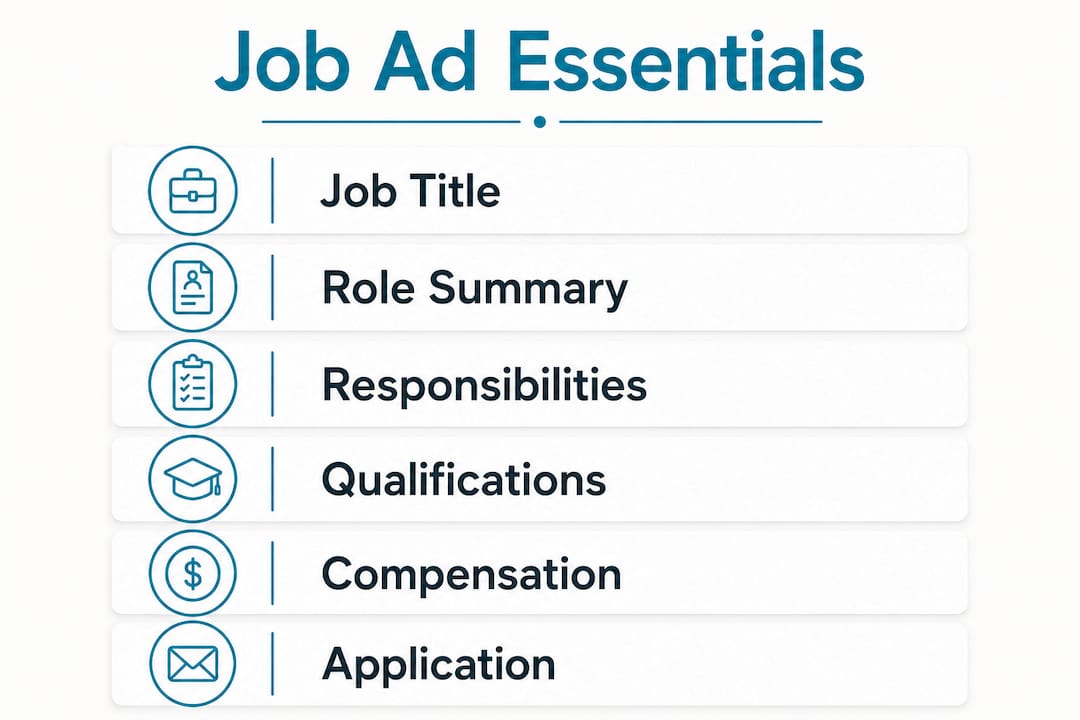
Every strong job posting shares the same structural backbone. Get these elements right, and the rest of the process becomes easier.
Job title. Use the title candidates actually search for. “Senior Accountant” outperforms “Financial Wizard” every time. ATS systems and job boards rank postings by keyword relevance, so a searchable title is your first filter for the right audience.
Role summary. Write two to four sentences that sell the opportunity. Explain what the team does, why this role matters, and what success looks like in the first six months. This is where most job listings fail. They describe the company, not the career opportunity.

Responsibilities. Write these as outcomes, not tasks. “Grow the client portfolio by 20% in year one” beats “Responsible for client management.” Outcome-based responsibilities attract candidates who focus on impact, which broadens your pool and raises the quality of applicants.
Qualifications. Split this into two lists: must-haves and nice-to-haves. Combining them into one long list causes strong candidates to self-select out if they miss one or two items. Keep the must-have list short and genuinely non-negotiable.
Compensation and work arrangement. Salary transparency can boost qualified applicant rates by up to 30%. State whether the role is on-site, hybrid, or remote. Candidates in Cairo factor commute time heavily into their decisions.
Application instructions. Tell candidates exactly what to submit and how. A clear call to action reduces drop-off and sets expectations from the start.
Pro Tip: Keep your must-have qualifications list to five items or fewer. Every additional requirement you add beyond genuine necessity shrinks your applicant pool without improving candidate quality.
Language is the most underused tool in recruitment. The words you choose determine who applies and who moves on.
The shift from third person to second person is the simplest change with the biggest return. Writing “you will lead” instead of “the candidate will lead” helps readers visualize themselves in the role. That mental image increases motivation to apply. It also makes the ad feel like a conversation rather than a legal document.
Inclusive language goes further than pronoun choice. Titles like “rockstar,” “ninja,” or “guru” signal a specific cultural fit that excludes experienced professionals who do not identify with those labels. Gender-coded words like “aggressive” or “dominant” in a requirements list statistically reduce applications from women. Neutral alternatives like “results-driven” or “collaborative” attract a wider range of qualified candidates.
“The best job ads act as sales tools for the role and company, emphasizing outcomes and impact over checklists of requirements. Experienced recruiters treat job description writing as a sales process that must balance realism with aspirational outcomes to attract diverse, high-caliber candidates.”
Outcome-based language also changes who applies. “Manage a team of five engineers” describes a task. “Build a team capable of shipping two product releases per quarter” describes an impact. The second version attracts candidates who think in results, which is exactly who you want.
Pro Tip: Run your draft through a free gender-decoder tool before publishing. These tools flag coded language that may be filtering out qualified candidates without your awareness.
Here are the core language principles that separate high-performing job postings from average ones:
Applicant tracking systems read your job posting before any human does. In 2026, most ATS platforms use natural language processing rather than exact keyword matching. That changes how you should write.
ATS systems now prefer naturally integrated, long-tail keywords over dense keyword lists. The target is 3–5 long-tail keywords per section, written as part of normal sentences. “Experience with financial reporting in ERP systems” works better than a bullet that just says “ERP, SAP, Oracle, Dynamics.” The first reads naturally. The second looks like stuffing and can actually hurt your ranking.
AI recruiting tools take this further. Platforms like Ai-orbis use the content of your job posting to run semantic matching against incoming CVs. That means the quality of your job ad directly determines the quality of your shortlist. A vague posting produces a vague match. A specific, well-structured posting gives the AI clear signals to rank candidates accurately.
Here is a practical framework for ATS-friendly job ad writing:
The AI drafting question is real. 70% of companies plan full AI adoption for recruiting by 2030. AI tools can generate a solid first draft in minutes. The risk is that AI-generated postings sound generic. Human editing for brand voice, cultural context, and role-specific nuance is what separates a posting that converts from one that gets ignored.
| Element | ATS-Friendly Approach | Common Mistake |
|---|---|---|
| Job title | Standard industry title with seniority level | Creative or internal titles |
| Keywords | Integrated into sentences naturally | Keyword lists at the bottom |
| Formatting | Plain text, consistent bullet points | Tables, graphics, mixed styles |
| Section headers | Standard labels (“Requirements”) | Custom or missing headers |
| Length | 700–2,000 words | Under 300 or over 2,500 words |
Most job postings fail for the same predictable reasons. Knowing them in advance saves you weeks of poor-quality applications.
Vague or inflated requirements. Asking for “10+ years of experience” for a mid-level role is the fastest way to lose strong candidates. They read it as a mismatch and move on. Write requirements that reflect the actual complexity of the work, not an idealized version of the hire.
Generic company descriptions. “We are a dynamic, fast-growing company” appears in thousands of postings. It tells candidates nothing. Replace it with one specific sentence about what your team is building and why it matters right now.
Hiding the salary. Phrases like “competitive compensation” signal that the number is either low or undefined. Applications drop significantly when candidates cannot assess fit before investing time in the process. State a range. It filters out mismatches and builds trust with serious applicants.
Long application forms. Applications drop sharply when forms require more than four fields beyond a resume and email address. Every additional required field is a candidate you may lose. Ask only for what you need at the screening stage.
Poor mobile formatting. Mobile-friendly job ads produce up to 50% less drop-off than poorly formatted ones. Use 6–10 bullet points per section, short paragraphs, and an overall length close to one A4 page. Most candidates in Egypt browse job listings on their phones.
Pro Tip: Test your job posting on a mobile screen before publishing. If you need to pinch and zoom to read the requirements, candidates will not bother.
Here is a quick comparison of what separates high-performing postings from weak ones:
| Weak posting | Strong posting |
|---|---|
| “Competitive salary” | Salary range stated clearly |
| “10+ years required” | Requirements matched to actual role complexity |
| Generic company blurb | One specific sentence about current team mission |
| Long application form | Resume and email only at initial stage |
| Desktop-only formatting | Mobile-optimized with short bullets |
A well-written job ad is the single highest-leverage action a hiring manager can take to improve candidate quality, reduce screening time, and cut the cost of a bad hire.
| Point | Details |
|---|---|
| Inclusive language drives volume | Gender-neutral, bias-free language increases applications by 42% without lowering quality. |
| Second-person framing converts | Writing “you will” instead of “the candidate will” helps readers visualize the role and apply. |
| ATS needs natural keywords | Integrate 3–5 long-tail keywords per section in sentences, not keyword lists. |
| Salary transparency builds trust | Stating a salary range can boost qualified applicant rates by up to 30%. |
| Mobile formatting reduces drop-off | Mobile-optimized postings with 6–10 bullets per section cut drop-off by up to 50%. |
Most hiring managers I have worked with think the interview process starts when candidates walk in the door. It does not. It starts the moment someone reads your job posting. That first impression determines whether the best candidates bother to apply at all.
The mistake I see most often is treating the job description template as a compliance document. Managers copy last year’s posting, update the date, and publish. The result is a generic listing that attracts generic candidates. The postings that consistently pull in strong applicants are the ones where someone actually thought about what makes this role worth taking.
The other thing I have learned is that clarity is kindness. A vague posting wastes everyone’s time. Candidates apply without knowing if they are a fit. Recruiters screen hundreds of irrelevant CVs. Writing a specific, honest posting is not just better marketing. It is a more respectful use of everyone’s time.
Iterating on your postings based on real data matters more than getting it perfect the first time. Track which postings generate strong applicants and which ones produce volume without quality. The patterns will tell you exactly what to change. AI tools can accelerate this process, but the judgment call about what “quality” looks like for your team still belongs to you.
— Sanad
Writing a great job posting is step one. What happens next determines whether that effort pays off.

Ai-orbis is built for exactly this moment. Once your job vacancy notice is live, Ai-orbis ingests applications from direct posts and regional job boards across the MENA market. It runs hard filtering on your must-have criteria, then uses semantic resume matching to rank candidates against the role rather than scanning for keyword overlap. Shortlisted candidates receive automatic invitations to AI-conducted voice and video interviews in Arabic or English, scored on structured competencies with built-in anti-cheat detection. Recruiters get a ranked pipeline with transcripts, scores, and evidence. Use the hiring-cost calculator to see exactly what a faster, cleaner process saves your business.
Optimal job posting length is between 700 and 2,000 words. Postings shorter than 300 words lack enough detail to attract serious candidates, while postings over 2,500 words see higher drop-off rates.
Using gender-neutral, bias-free language and avoiding titles like “rockstar” or “ninja” increases applications by 42%. This broadens your candidate pool without reducing quality.
Salary transparency can boost qualified applicant rates by up to 30%. Stating a range filters out mismatches early and builds candidate trust before the first interview.
ATS systems in 2026 prefer 3–5 long-tail keywords per section, integrated naturally into sentences. Keyword stuffing reduces readability and can hurt your posting’s ranking.
The most common mistake is combining must-have and nice-to-have qualifications into a single long list. Strong candidates self-select out when they see one or two gaps, even if they are otherwise an excellent fit.
 importance of shortlisting
 Discover best practices for shortlisting candidates to ensure efficient hiring. Learn essential criteria and tools for identifying top talent.
Read article how to advertise jobs
 Discover effective job advertising strategies to attract top talent. Learn key tactics to optimize your recruitment and fill your pipeline efficiently.
Read articleRun your first roles through Orbis — screening, AI interviews, and scoring, end to end.
English + العربية · 3-model jury scoring · integrity evidence on every interview