Blog
13 min read
Job Advertising Strategies That Attract Top Talent
Discover effective job advertising strategies to attract top talent. Learn key tactics to optimize your recruitment and fill your pipeline efficiently.
Discover effective job advertising strategies to attract top talent. Learn key tactics to optimize your recruitment and fill your pipeline efficiently.

Job advertising is the practice of strategically promoting open positions to attract qualified candidates efficiently and cost-effectively. Done well, it fills your pipeline with people who actually meet your requirements. Done poorly, it wastes budget on unqualified applicants and drags out time-to-hire. The difference between those two outcomes comes down to three things: what your ad says, where you post it, and how you measure results. Recruiters in Egypt’s competitive hiring market face the same structural challenges as anywhere else. The tactics in this guide are grounded in 2026 data and built for professionals who want results, not theory.
The most effective job ads function as targeted marketing campaigns, not plain role descriptions. That framing changes everything about how you write them.
The single highest-impact element is salary transparency. Including a salary range increases applicant volume by 70% and applicant quality by 66%. That is not a minor lift. It means fewer unqualified applicants and more people who know the role fits their expectations before they apply.

Language tone matters almost as much. Ads written with demand-heavy phrasing (“must have,” “required to,” “expected to”) read like a compliance checklist. Ads written with growth-oriented language (“you will build,” “you will lead,” “you will shape”) read like an opportunity. The second type attracts candidates who are motivated, not just available.
Adding a “Day in the Life” section or a clear company mission statement increases candidate engagement by 25–40%. Candidates want to picture themselves in the role before they commit to applying. Give them that picture.
The technical side also matters. ATS-friendly job titles with optimized keywords reduce resume rejection rates by 75%. Avoid internal titles like “Growth Ninja” or “People Champion.” Use the terms candidates actually search: “Marketing Manager,” “Software Engineer,” “HR Specialist.”
Key elements of a high-performing job ad:
Pro Tip: Write your job title as a search query. Ask yourself: “Would a qualified candidate type this exact phrase into Indeed or LinkedIn?” If the answer is no, rewrite it.
Timing and channel selection are the two most underused levers in employment advertising. Most recruiters post when it is convenient for them, not when candidates are most active.
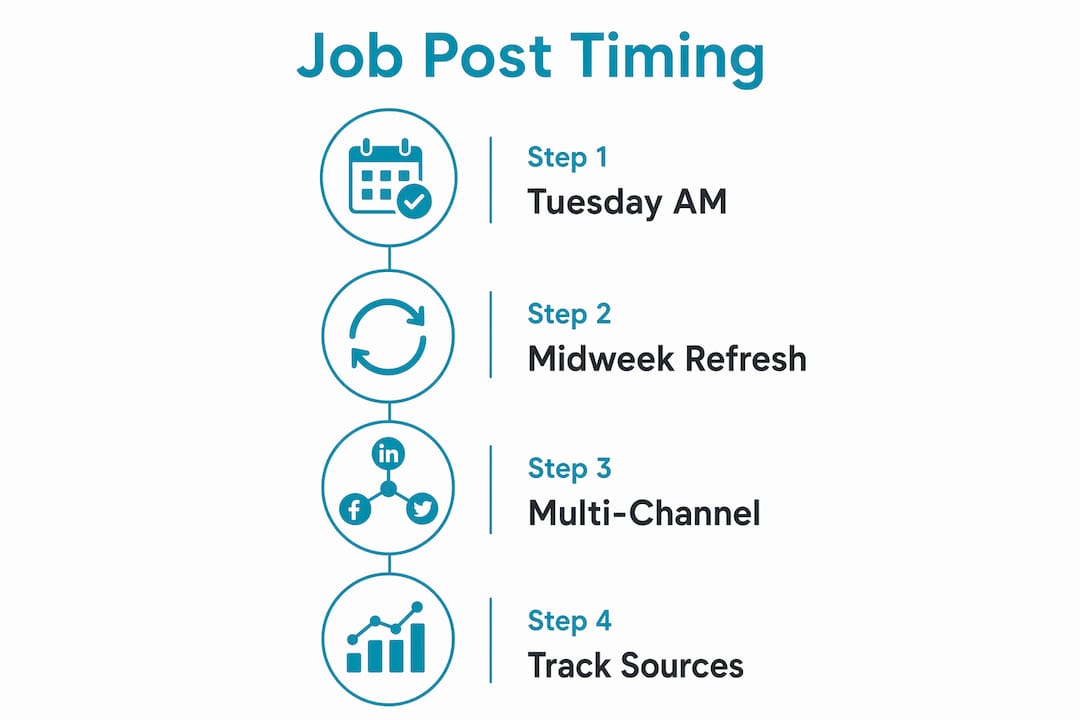
58% of job postings go live Monday through Wednesday, and engagement data confirms that is the right window. Tuesday between 11:00 AM and 12:00 PM is the peak engagement slot on Indeed. Posting on a Friday afternoon means your ad competes for attention when most candidates have mentally checked out for the week.
Channel strategy matters just as much as timing. The right mix depends on the role and seniority level:
| Channel | Best for | Cost model |
|---|---|---|
| Career site | All roles | Free |
| General job boards | High-volume, broad roles | Pay-per-click or flat fee |
| Niche boards | Specialized or technical roles | Flat fee or subscription |
| Professional and senior roles | Pay-per-click or sponsored | |
| Social media | Employer branding, entry-level | Paid boost or organic |
Multi-channel posting with UTM tracking gives you source-level data on which channels deliver quality applicants, not just volume. That data is what lets you shift budget toward what works.
Pro Tip: Post your ad on Tuesday morning, then schedule a refresh or repost on Wednesday morning if applications are slow. Two early-week posts outperform one Friday post every time.
The goal of a well-written job ad is not to maximize applications. It is to attract the right applicants and discourage the wrong ones. Precise candidate filtering via screening questions and salary transparency reduces unqualified applications and shortens time-to-hire dramatically.
Most recruiters make the same mistake: they write requirements that are either too vague or too long. “Strong communication skills” is too vague. A list of 20 requirements is too long. Neither approach filters effectively.
The fix is specificity combined with brevity. Write 5–7 responsibilities that reflect what the person will actually do in the first 90 days. Write 3–5 must-have requirements that are genuinely non-negotiable. List 2–3 nice-to-have skills separately so strong candidates do not self-select out because they lack one optional skill.
Screening questions added to the application form are one of the most effective filtering tools available. A single well-designed question, such as “Describe a time you managed a project with a tight deadline,” tells you more than a CV scan. Two or three targeted questions can cut unqualified applications significantly before a recruiter reviews a single resume.
What to include and what to cut:
Pro Tip: Read your job ad as if you are a qualified candidate who is slightly underconfident. If the requirements list would make that person hesitate to apply, it is too long or too vague.
Posting a job ad and waiting is not a strategy. Cost per hire and source quality metrics help recruiters identify the most efficient channels and improve ROI. Tracking these numbers turns job listing optimization from guesswork into a repeatable process.
The core metrics every recruiter should track:
A/B testing job ads for 5–7 days can increase click-through rates by 35% and conversion rates by up to 43%. Test one variable at a time: the job title, the opening sentence, the salary placement, or the call to action. Do not change everything at once or you will not know what moved the needle.
Refresh ads every 30–60 days based on performance data. An ad that performed well in its first two weeks often loses momentum as the candidate pool who saw it moves on. A fresh headline and updated opening paragraph can restore visibility without requiring a full rewrite.
Pro Tip: Connect your ATS to Google Analytics using UTM parameters. This gives you a full funnel view from ad impression to hired candidate, by channel, by ad version, and by posting date.
Fixed monthly budgets for recruitment advertising are becoming obsolete. Consumption-based spending, where you set a target cost per qualified application and pause channels that exceed it, delivers better ROI than committing a flat fee to a channel regardless of results.
The practical shift looks like this: instead of allocating a fixed amount to a job board each month, you set a maximum cost per qualified application, say the equivalent of 1,500 Egyptian pounds. Any channel that consistently exceeds that threshold gets paused or reduced. Any channel that comes in under it gets more budget.
For teams with limited budgets, the approach is different but equally data-driven:
Recruitment marketing automation platforms reduce manual effort significantly by integrating multi-channel ad management with real-time optimization. For hiring managers running lean teams in Egypt’s SME sector, that kind of automation is not a luxury. It is the difference between a process that scales and one that collapses under volume.
| Budget level | Recommended approach | Expected outcome |
|---|---|---|
| Low (under $200/month) | Free listings plus 72-hour paid boost | Steady applicant flow for 1–2 roles |
| Mid ($200–$800/month) | Multi-board posting with UTM tracking | Broader reach with source-level data |
| High ($800+/month) | Automated multi-channel with ATS integration | Full-funnel optimization and passive candidate nurturing |
Pro Tip: Before adding budget to a new channel, calculate your current cost per qualified application from existing channels. That number is your benchmark. Any new channel must beat it within 30 days or get cut.
Effective job advertising combines transparent salary data, precise requirements, data-driven timing, and channel-level performance tracking to consistently attract qualified candidates while controlling cost per hire.
| Point | Details |
|---|---|
| Salary transparency drives volume and quality | Including a salary range increases applicant volume by 70% and quality by 66%. |
| Post on Tuesday mornings for peak engagement | 58% of job postings go live Monday through Wednesday, with Tuesday 11:00 AM as the peak slot. |
| Filter with specificity, not length | Use 5–7 responsibilities and 3–5 hard requirements to attract fits and discourage mismatches. |
| Track cost per qualified application by channel | Source quality metrics reveal which channels deliver hires, not just applicants. |
| Shift to consumption-based budgeting | Set a cost-per-application target and pause any channel that consistently exceeds it. |
Recruiters underestimate how much a job ad is a piece of marketing. It has a headline, a value proposition, a call to action, and a target audience. The moment you start thinking about it that way, your results change.
The biggest mistake I see is the “post and pray” approach: write a generic description, post it on one board, and wait. That approach made sense when job boards had less competition. It does not work now. Candidates in Egypt’s job market, especially in Cairo and Alexandria, have more options than ever. Your ad competes with every other open role in their field.
The second mistake is ignoring employer branding. Candidates research companies before applying. If your ad links to a career page that has not been updated in two years, or a LinkedIn company page with no recent posts, qualified candidates will pass. Employer branding is not a separate project from recruitment. It is part of every ad you post.
The third mistake is treating automation as a replacement for judgment. Platforms that automate targeting, creative rotation, and budget allocation are genuinely useful. But they optimize toward the metrics you give them. If you feed them the wrong success metric, they will get very efficient at the wrong thing. Define “qualified application” precisely before you automate anything.
The recruiters who consistently outperform their peers treat every job ad as a living asset. They test it, refresh it, and retire it when it stops performing. They know their cost per qualified application by channel. They have a candidate persona for every role they hire regularly. That level of discipline is what separates a filled role from a great hire.
— Sanad
Posting a well-crafted ad is step one. What happens after applications arrive is where most hiring processes slow down.
Ai-orbis is built for exactly that bottleneck. The platform ingests applications from direct posts and regional job boards, runs hard filtering on must-have criteria, and uses semantic resume matching to rank candidates against the role rather than keyword-matching CVs. Shortlisted candidates receive automatic invitations to AI-conducted voice and video interviews in Arabic or English, scored on structured competencies with built-in anti-cheat detection. Recruiters get a ranked pipeline with transcripts, scores, and evidence. The Ai-orbis platform cuts time-to-hire from weeks to days, making it a practical fit for SMEs and growing teams across Egypt and the wider MENA region.
Job advertising is the practice of promoting open positions across paid and unpaid channels to attract qualified candidates. It includes writing the ad, selecting distribution channels, setting budgets, and measuring performance.
Including a salary range increases applicant volume by 70% and applicant quality by 66%, according to SHRM 2026 data. Candidates self-screen based on compensation fit before applying, which reduces unqualified submissions.
Tuesday between 11:00 AM and 12:00 PM is the peak engagement window on Indeed. Posting Monday through Wednesday consistently outperforms late-week posting across major job boards.
Track cost per application and cost per qualified application by channel, then layer in source quality scores that reflect whether those hires stayed and performed. A/B testing headlines and calls to action for 5–7 days can improve click-through rates by up to 35%.
Start with free listings and a short paid boost of around $1 per day for the first 72 hours on a major board. Set a maximum cost per qualified application as your budget benchmark, and pause any channel that consistently exceeds it.
 importance of shortlisting
 Discover best practices for shortlisting candidates to ensure efficient hiring. Learn essential criteria and tools for identifying top talent.
Read article job vacancy notice
 Learn to craft a compelling job ad that attracts top talent. Stand out in a competitive market and enhance your application quality today!
Read articleRun your first roles through Orbis — screening, AI interviews, and scoring, end to end.
English + العربية · 3-model jury scoring · integrity evidence on every interview