Blog
10 min read
Shortlisting Candidates: Best Practices for HR Teams
Discover best practices for shortlisting candidates to ensure efficient hiring. Learn essential criteria and tools for identifying top talent.
Discover best practices for shortlisting candidates to ensure efficient hiring. Learn essential criteria and tools for identifying top talent.

Shortlisting is the recruitment process of narrowing a large applicant pool to a focused group of qualified candidates based on defined criteria, enabling efficient and fair selection for interviews. Done well, it protects your time, reduces bias, and produces a defensible hiring record. Industry best practice targets 6–8 candidates from a pool of 200 applicants for initial interviews. That ratio reflects a core truth about candidate shortlisting: the goal is not to find every acceptable candidate but to identify the strongest ones quickly enough to act on them.
The foundation of any sound shortlisting process is a clear split between essential and desirable criteria. Essential criteria are non-negotiable: a valid engineering license, fluency in Arabic, or three years of direct sales experience. Desirable criteria are genuine advantages but not dealbreakers. Separating these two categories prevents premature exclusion of strong candidates who meet every requirement that actually matters.
The primary tool for applying those criteria is a candidate scorecard. A scorecard assigns a numeric rating to each criterion so that every reviewer evaluates candidates on the same scale. Scorecards should contain no more than 10 criteria to stay practical in high-volume environments. A 15-criterion scorecard sounds thorough, but it slows reviewers down and produces inconsistent scores when fatigue sets in.

Screening questions add a third layer of evaluation that resumes cannot provide. A well-written screening question might ask a candidate to describe a specific situation, quantify a result, or explain a technical decision. Screening questions surface skills and qualities that a formatted CV simply cannot capture. For Egyptian recruiters handling roles in finance, technology, or engineering, a single targeted question often separates a genuinely qualified candidate from one who has learned to write a strong resume.
Pro Tip: Write your scorecard before you post the job, not after applications arrive. Criteria created under pressure tend to reflect the first strong resume you read, not the actual role requirements.
Key shortlist criteria to define upfront:
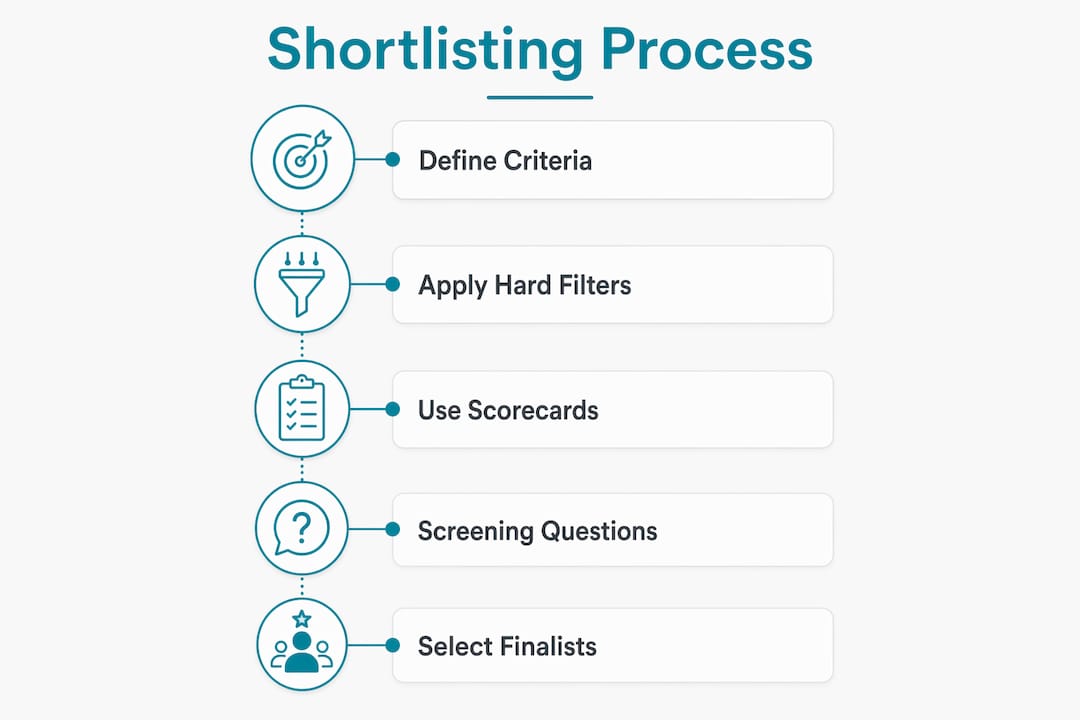
A structured sequence prevents the most common shortlisting failure: inconsistent evaluation caused by reviewers applying different standards at different stages.
Confirm your criteria before opening applications. Lock the scorecard and screening questions before you review a single resume. Changing criteria mid-review introduces bias and creates compliance risk.
Apply essential criteria as a hard filter first. Remove any application that fails a non-negotiable requirement. This step should be fast and binary. A candidate without a required license is not shortlisted regardless of other strengths.
Score remaining applications against the full scorecard. Assign numeric ratings for each criterion. Read the resume, cover letter, and any portfolio materials before scoring. Avoid rating from memory after reviewing 50 applications in a row.
Use screening question responses to refine the ranked list. Candidates who scored similarly on the scorecard often separate clearly when you read their written or recorded responses. A vague answer to a specific question is meaningful data.
Run a preliminary compliance check. Verify that the shortlist reflects the diversity of your applicant pool. If every shortlisted candidate shares the same university, graduation year, or background, that pattern warrants a second look at your criteria.
Finalize the shortlist at 6–8 candidates for standard roles. For senior or highly specialized positions, a shortlist of 4–5 is appropriate. For high-volume graduate roles, 10–12 may be justified if interview capacity allows.
Assign a diverse interview panel before scheduling. Diverse interview panels reduce bias by incorporating multiple perspectives into candidate evaluation. Confirm panel composition before candidates receive their invitations.
The numbered sequence matters because each step depends on the previous one. Skipping the hard filter and going straight to scorecard review wastes time on ineligible candidates. Skipping the diversity check produces shortlists that expose organizations to legal and reputational risk.
Unconscious bias is the single most documented threat to shortlist quality. Reviewers consistently rate candidates more favorably when names, universities, or neighborhoods match their own background. Anonymized CVs and diverse panels are the two most effective countermeasures. Anonymizing removes name, gender, and graduation year from the initial review. Diverse panels catch patterns that a single reviewer cannot see. For Egyptian organizations, where university prestige carries significant social weight, anonymization is particularly valuable.
High-volume recruitment in Egypt, especially for customer service, retail, or banking roles, can mean hundreds of applications per week. Speed pressure causes reviewers to abandon scorecards and rely on gut instinct. The fix is not to review faster but to filter harder at the essential criteria stage. A strict hard filter at step one reduces the scored pool to a manageable size without sacrificing quality.
Inclusive job ads that emphasize skills and demonstrated growth rather than formal credentials broaden the talent pool and improve shortlist diversity. A degree requirement for a role that genuinely needs analytical thinking excludes self-taught candidates who may outperform degree holders. Review each essential criterion and ask whether it predicts job performance or simply filters for familiarity.
AI and applicant tracking systems speed up shortlisting by automating scorecard organization, application sorting, and interview scheduling. That automation frees recruiters to focus on qualitative judgment. Platforms built on semantic resume matching rank candidates against the actual role requirements rather than keyword frequency, which produces more accurate initial filters. Technology works best when it handles volume and humans handle nuance.
Pro Tip: Add one open-ended screening question that has no single correct answer. Candidates who engage thoughtfully with an ambiguous question often outperform those who give technically correct but formulaic responses.
Additional best practices:
Communication after shortlisting is where many Egyptian employers lose ground on employer brand. Candidates who receive no response after applying form a lasting negative impression of the organization. Timely and personalized communication to all candidates, whether they advance or not, signals professionalism and respect.
Effective communication practices include:
The tone of rejection and invitation messages should be warm but direct. Avoid vague language like “we will be in touch.” State clearly whether the candidate has advanced or not. Candidates respect clarity even when the answer is no.
Effective shortlisting requires clear criteria, consistent scoring, and timely communication to produce a defensible and high-quality candidate pipeline.
| Point | Details |
|---|---|
| Set criteria before reviewing | Lock your scorecard and screening questions before opening any application. |
| Cap scorecards at 10 criteria | More than 10 criteria slows reviewers and produces inconsistent scores. |
| Target 6–8 candidates per role | This range balances interview capacity with competitive candidate selection. |
| Anonymize to reduce bias | Removing names and universities from initial review improves shortlist fairness. |
| Communicate with every applicant | Timely responses to all candidates, including rejections, protect employer brand. |
Recruiters spend a lot of energy on job ads and interviews, but the shortlist is where the real decision happens. If the wrong candidates make it through, the interview stage cannot fix it. I have seen organizations with excellent interviewers consistently hire poorly because their shortlisting criteria were vague or applied inconsistently.
The scorecard is the most underused tool in Egyptian recruitment. Most teams know they should use one, but they build it with 15 criteria, share it inconsistently, and abandon it under time pressure. A scorecard with six well-chosen criteria, applied by two reviewers independently, produces better shortlists than a 15-point rubric used by one tired recruiter on a Friday afternoon.
The other thing I would push back on is the instinct to treat a degree as a proxy for capability. Egypt has a large population of self-taught professionals in technology, finance, and marketing who are systematically excluded by credential requirements that were never examined critically. Removing a degree requirement and replacing it with a skills-based screening question often improves both the quality and the diversity of the shortlist.
Inclusive recruiting is not a compliance exercise. It is a competitive advantage in a market where the best candidates have options. The organizations that figure this out first will build better teams faster.
— Sanad
Egyptian HR teams managing high application volumes face a specific problem: the manual screening bottleneck between job post and first interview. Ai-orbis is built to close that gap.
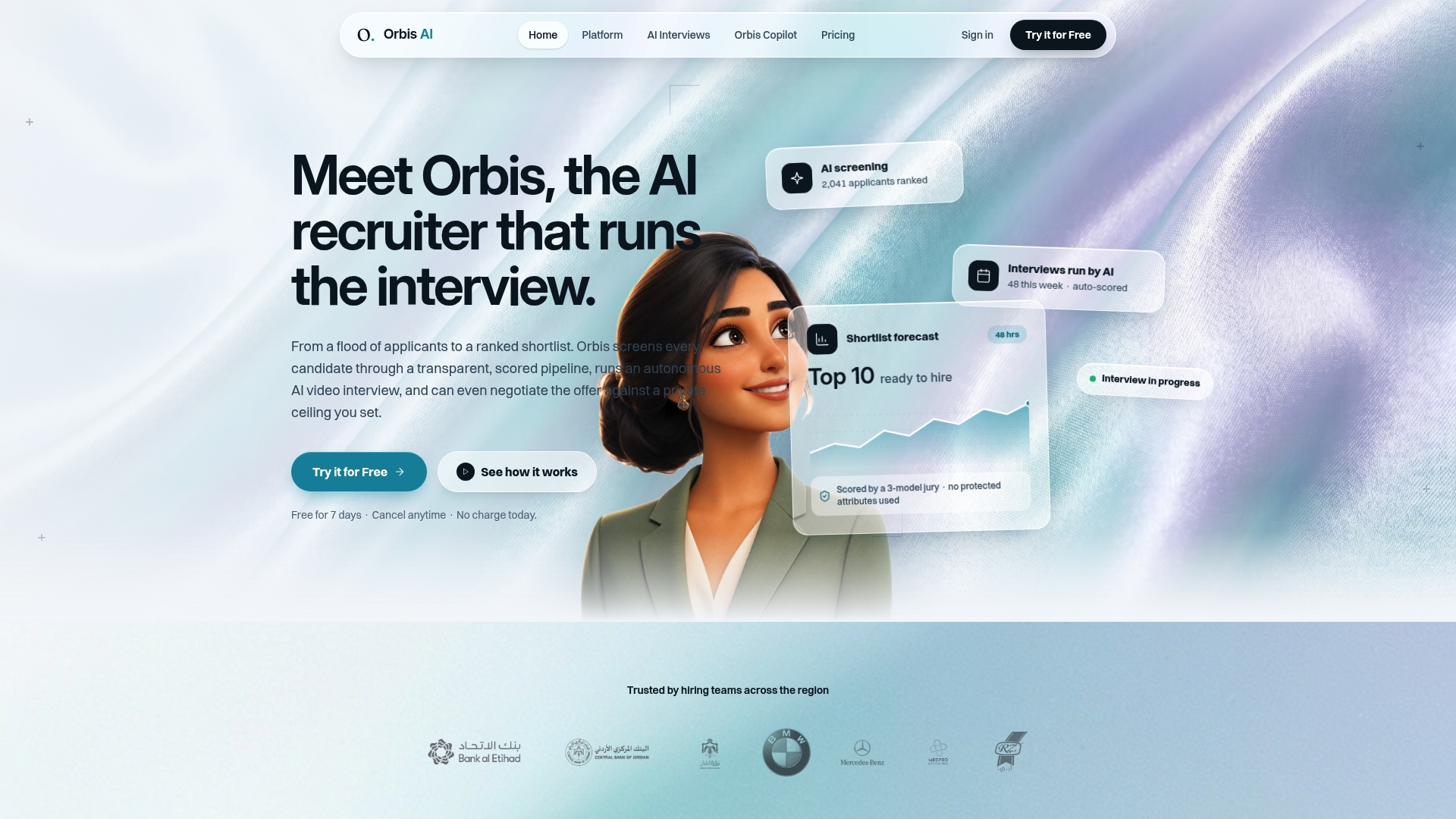
The Ai-orbis platform ingests applications from regional job boards and direct posts, applies hard filters on essential criteria, then ranks remaining candidates using semantic matching against the actual role requirements. Shortlisted candidates receive automatic invitations to AI-conducted voice and video interviews in Arabic or English, scored on structured competencies with built-in anti-cheat detection. Recruiters receive a ranked pipeline with transcripts, scores, and evidence, cutting time-to-hire from weeks to days. For teams that want to understand the technology behind the process, the AI recruiting glossary covers every relevant term in plain language.
Shortlisting is the process of reducing a large applicant pool to a smaller group of qualified candidates for interviews, based on defined essential and desirable criteria. The standard target is 6–8 candidates from a pool of 200 applicants.
For most roles, 6–8 candidates is the recommended shortlist size. Senior or highly specialized roles may warrant 4–5, while high-volume graduate programs may justify up to 10–12 if interview capacity supports it.
Anonymizing CVs to remove names, universities, and graduation years reduces unconscious bias at the initial review stage. Using a diverse interview panel adds a second layer of protection during evaluation.
A scorecard should cover no more than 10 criteria, split between essential requirements and desirable qualities. Each criterion should be rated on a consistent numeric scale and applied independently by at least two reviewers.
Use screening questions after the hard filter stage to differentiate candidates who score similarly on the scorecard. A single well-designed question often reveals more about a candidate’s actual capability than their entire resume.
 job vacancy notice
 Learn to craft a compelling job ad that attracts top talent. Stand out in a competitive market and enhance your application quality today!
Read article how to advertise jobs
 Discover effective job advertising strategies to attract top talent. Learn key tactics to optimize your recruitment and fill your pipeline efficiently.
Read articleRun your first roles through Orbis — screening, AI interviews, and scoring, end to end.
English + العربية · 3-model jury scoring · integrity evidence on every interview