Blog
11 min read
Talent Pooling for Recruiters: A 2026 Strategy Guide
Discover the benefits of talent pooling for recruiters. Learn how this proactive strategy can streamline hiring and enhance candidate quality in 2026.
Discover the benefits of talent pooling for recruiters. Learn how this proactive strategy can streamline hiring and enhance candidate quality in 2026.

Talent pooling is defined as the proactive process of identifying, engaging, and managing qualified candidates before a vacancy opens. Unlike reactive hiring, which starts the clock at job posting, a well-built talent pool keeps your pipeline warm so the best candidates are already known when a role opens. For HR professionals in Egypt’s competitive labor market, where top engineering, technology, and finance talent moves fast, this shift from reactive to proactive is the difference between a 90-day search and a 10-day shortlist. Done right, talent pooling cuts time-to-fill and cost-per-hire while raising the quality of every hire you make.
Talent pooling is the practice of building a curated, segmented database of candidates who have been assessed, engaged, and categorized by skill, role type, and readiness. The industry also uses the term talent community to describe a more actively nurtured version of the same concept. Both terms describe the same core shift: from waiting for applicants to actively cultivating relationships with potential hires.
Reactive hiring starts at zero every time a seat opens. A recruiter posts a job, waits for applications, screens from scratch, and loses weeks to a process that repeats identically for every vacancy. Talent pooling breaks that cycle by doing the sourcing and early assessment work in advance.
The practical differences are significant:
Talent communities reduce time-to-fill by up to 40% and lower cost-per-hire for high-volume roles. That figure reflects the compounding advantage of warm leads: candidates who already know your brand, have completed an initial assessment, and are ready to move quickly when you call.
The warm-lead advantage is especially relevant in Egypt’s market. Candidates in Cairo, Alexandria, and the Delta region often receive multiple offers simultaneously. A recruiter who already has a relationship with a candidate, and has already assessed their competencies, moves to offer stage far faster than one starting cold.
Building a talent pool that actually performs requires a structured approach. Most recruiters make the mistake of starting too broad. The most effective first step is to focus on your highest-volume roles.
Start with your most frequently hired roles. Build your first community around the job families you hire for most often. In Egypt, this often means software engineers, customer service specialists, or sales professionals. Depth in one segment beats shallow coverage across ten.
Source across multiple channels. LinkedIn, Wuzzuf, Forasna, university career fairs, employee referral programs, and previous applicants are all valid sources. Each channel reaches a different candidate segment, so using only one leaves significant talent undiscovered.
Apply skills-first and competency-based assessment early. Shifting from CV screening to competency-based evaluation improves quality of hire and reduces bias. Resumes tell you where someone has been. Competency assessments tell you what they can actually do.
Segment your pool deliberately. Segmenting candidates by role type, geographic region, and readiness status enhances sourcing efficiency and pipeline responsiveness. A pool with no segmentation is just a spreadsheet. A segmented pool is a searchable asset.
Maintain pipeline hygiene. Candidates go stale. Set a cadence, quarterly at minimum, to re-engage candidates, update their status, and remove those who have accepted roles elsewhere or are no longer a fit.
Keep employer brand consistent. Coherent employer value proposition storytelling increases candidate trust and engagement in talent communities. Every touchpoint, from your job description to your LinkedIn posts to your automated emails, should reflect the same brand voice.
Pro Tip: Build a simple skills inventory for each candidate segment. Track not just current skills but growth trajectory. A candidate who is 80% ready today and actively developing is often a better long-term bet than one who is 100% ready but plateaued.
The payoff for disciplined pool management is measurable. Companies using branded engagement and gamified challenges saw a 43% increase in applications and 290% pipeline volume growth. That is not a marginal gain. It reflects what happens when candidates feel connected to a brand rather than processed by it.
The most effective talent pools draw from both inside and outside the organization. Treating internal and external sourcing as separate functions is one of the most common and costly mistakes in talent acquisition strategies.

Internal talent pools serve a distinct purpose: succession planning and career development. Internal mobility accelerates onboarding and increases retention compared to external hiring. An employee promoted from within already understands the culture, the systems, and the expectations. That knowledge has real dollar value in reduced ramp time.
External pools fill the gaps that internal mobility cannot. They draw from:
Internal talent marketplaces empower employees to find relevant growth opportunities, supporting retention and succession within talent pools. Platforms that surface internal opportunities to employees before posting externally reduce attrition and signal that the organization invests in its people.
The key to keeping external candidates engaged long term is relevance. Generic newsletters do not work. Candidates stay engaged when you send them content tied to their specific skills and career interests. A software engineer in your pool wants to hear about your technology stack and engineering culture, not a company-wide update about your annual picnic.
Pro Tip: Tag every candidate in your pool with a “last contacted” date and a “readiness score.” Review anyone who has not been contacted in 90 days. A brief, personalized check-in email takes two minutes and keeps the relationship alive.
Measuring a talent pool without the right metrics produces false confidence. The metrics that matter most are not the easiest to track.
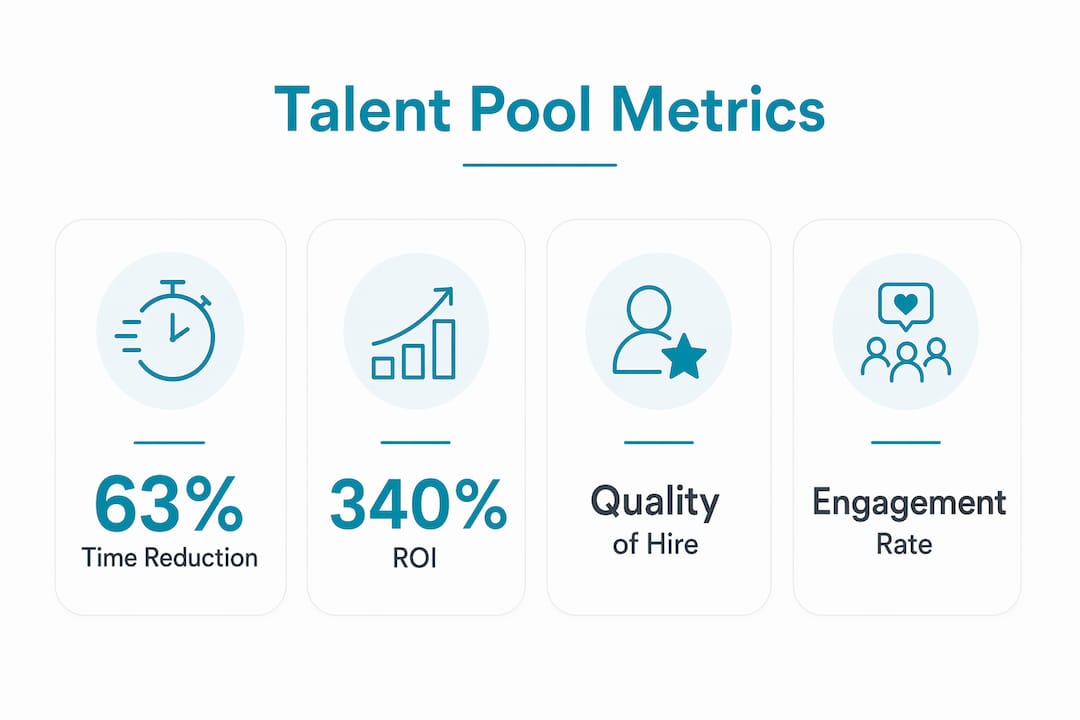
| Metric | What it measures | Why it matters |
|---|---|---|
| Quality of hire | Performance and retention of hired candidates | The single most important indicator of pool health |
| Pipeline conversion rate | Percentage of pool candidates who reach offer stage | Reveals whether sourcing and assessment are aligned |
| 12-month retention | Whether new hires stay past one year | Validates that pool candidates are genuinely well-matched |
| Time-to-fill from pool | Days from vacancy to accepted offer for pool candidates | Quantifies the speed advantage of proactive sourcing |
| Pipeline volume | Total number of qualified, segmented candidates | Indicates whether the pool can absorb sudden hiring surges |
CHROs now prioritize quality of hire over time-to-fill as the primary indicator of talent acquisition health. That shift reflects a maturation in how organizations measure recruiting. Fast hires that leave in six months cost more than slower hires who stay for five years.
Technology plays a direct role in making these metrics trackable and actionable. AI and skills-first platforms enable real-time pipeline analytics, semantic matching, and autonomous interviewing to keep talent pools performing at scale. Semantic resume matching ranks candidates against the actual requirements of a role rather than counting keyword occurrences. That distinction matters enormously when you are sorting through a pool of 500 candidates for a niche technical role.
Autonomous AI interviewers take the process further by conducting structured competency interviews at scale, scoring candidates on consistent criteria, and flagging anomalies like off-screen prompting or AI-assisted answers. The result is a ranked, evidence-backed shortlist rather than a stack of unreviewed CVs.
Companies using structured skills-based workforce planning achieved a 63% reduction in time-to-fill and 340% ROI. Those numbers reflect what happens when technology handles the repeatable parts of assessment and recruiters focus on relationship-building and final evaluation.
Talent pooling works because it replaces reactive, zero-start hiring with a continuously maintained pipeline of pre-assessed, segmented candidates who are ready to move when a vacancy opens.
| Point | Details |
|---|---|
| Start with high-volume roles | Build your first pool around the job families you hire most often to generate fast, measurable results. |
| Segment by skill and readiness | Organize candidates by role type, location, and readiness status so sourcing is fast and precise when a vacancy opens. |
| Combine internal and external sourcing | Use internal mobility for succession and external pools for net-new talent, and keep both actively maintained. |
| Track quality of hire above all | Quality of hire and 12-month retention reveal whether your pool is producing genuinely well-matched candidates. |
| Use AI to assess at scale | Semantic matching and autonomous AI interviews score candidates consistently, giving recruiters ranked, evidence-backed shortlists. |
Most talent pools I have seen fail for the same reason: they are built as a one-time project rather than an ongoing practice. A recruiter spends two weeks sourcing 300 candidates, tags them in the ATS, and then the pool sits untouched for eight months. By the time a vacancy opens, half the candidates have moved on and the other half have forgotten the company exists.
The organizations that get real value from candidate pipeline management treat it like a product, not a project. They assign ownership. They set engagement cadences. They measure pool health the same way a sales team measures pipeline health: by volume, velocity, and conversion.
The second failure mode is building pools without a skills inventory. A pool organized only by job title is nearly useless when the role you need to fill has a specific technical requirement. Tagging candidates with verified skills, not just self-reported ones, is what makes a pool searchable and fast.
The future of recruitment in Egypt and across the MENA region will belong to organizations that build talent communities now, before the competition for top candidates intensifies further. Technology makes this achievable even for small HR teams. The constraint is not tools. It is discipline and consistency.
— Sanad
Ai-orbis is built specifically for the MENA market, and its architecture reflects the realities of high-volume hiring in Egypt and the wider region.
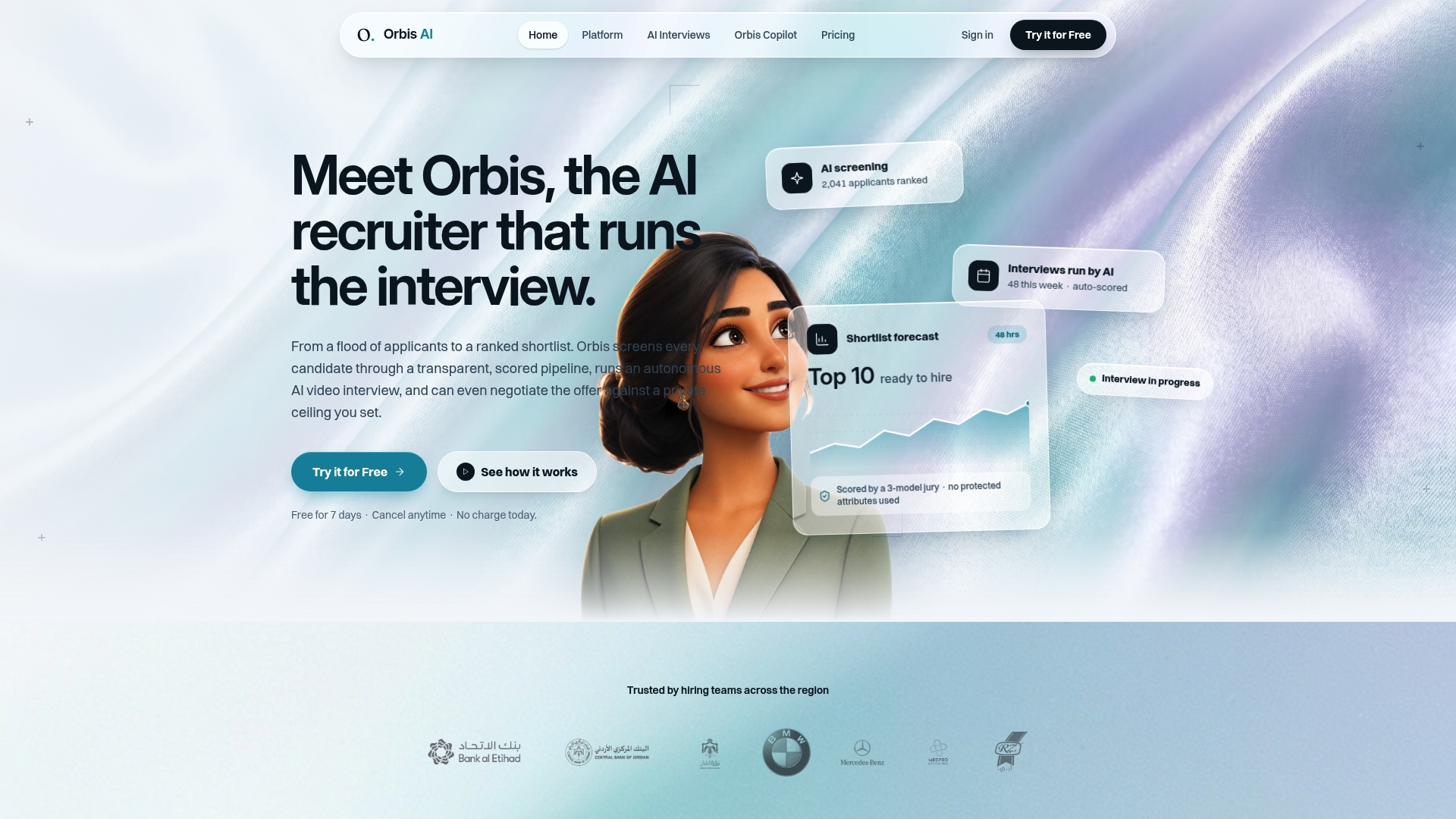
The Ai-orbis platform ingests applications from direct posts and regional job boards, runs hard filtering on must-have criteria, and uses semantic matching to rank candidates by actual role fit rather than keyword overlap. Shortlisted candidates receive automatic invitations to AI-conducted voice and video interviews in Arabic or English, scored on structured competencies with built-in anti-cheat detection. Recruiters receive a ranked pipeline with transcripts, scores, and evidence, cutting time-to-hire from weeks to days. For HR teams building and managing talent pools at scale, the AI recruiting glossary is a practical starting point for understanding the technology behind modern candidate pipeline management.
Talent pooling is the proactive practice of building and maintaining a database of pre-assessed, segmented candidates for current and future hiring needs. It replaces reactive job-posting cycles with a ready pipeline of warm leads.
Start by identifying your highest-volume roles, then source candidates through job boards, referrals, previous applicants, and career events. Assess candidates using competency-based methods and segment them by skill, location, and readiness before adding them to your pool.
A talent pool is a broad, standing database of pre-assessed candidates organized by skill and readiness. A talent pipeline is a role-specific queue of candidates actively moving through a current hiring process.
Talent pools require review at least quarterly. Recruiters should re-engage candidates, update readiness scores, and remove anyone who has accepted a role elsewhere or no longer fits the target profile.
Quality of hire, 12-month retention, pipeline conversion rate, and time-to-fill from pool are the four metrics that best reflect whether a talent pool is performing. CHROs increasingly treat quality of hire as the primary indicator of talent acquisition health.
 importance of shortlisting
 Discover best practices for shortlisting candidates to ensure efficient hiring. Learn essential criteria and tools for identifying top talent.
Read article job vacancy notice
 Learn to craft a compelling job ad that attracts top talent. Stand out in a competitive market and enhance your application quality today!
Read articleRun your first roles through Orbis — screening, AI interviews, and scoring, end to end.
English + العربية · 3-model jury scoring · integrity evidence on every interview